Publication Details
Rotational grazing enhances ecosystem multifunctionality in alpine pastoral grasslands
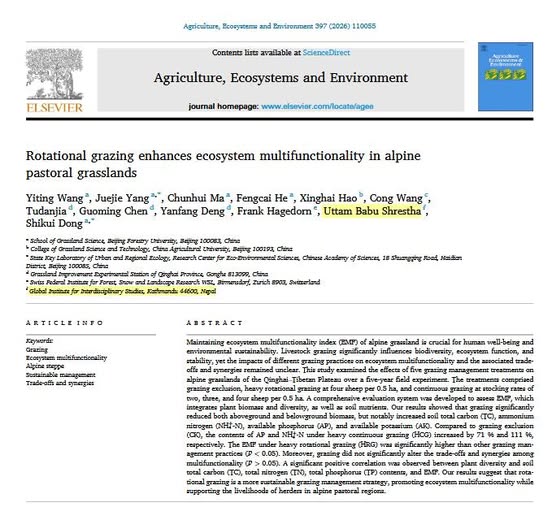
Maintaining ecosystem multifunctionality index (EMF) of alpine grassland is crucial for human well-being and environmental sustainability. Livestock grazing significantly influences biodiversity, ecosystem function, and stability, yet the impacts of different grazing practices on ecosystem multifunctionality and the associated trade-offs and synergies remained unclear. This study examined the effects of five grazing management treatments on alpine grasslands of the Qinghai–Tibetan Plateau over a five-year field experiment. The treatments comprised grazing exclusion, heavy rotational grazing at four sheep per 0.5 ha, and continuous grazing at stocking rates of two, three, and four sheep per 0.5 ha. A comprehensive evaluation system was developed to assess EMF, which integrates plant biomass and diversity, as well as soil nutrients. Our results showed that grazing significantly reduced both aboveground and belowground biomass, but notably increased soil total carbon (TC), ammonium nitrogen (NH4+-N), available phosphorus (AP), and available potassium (AK). Compared to grazing exclusion (CK), the contents of AP and NH4+-N under heavy continuous grazing (HCG) increased by 71 % and 111 %, respectively. The EMF under heavy rotational grazing (HRG) was significantly higher than other grazing management practices (P < 0.05). Moreover, grazing did not significantly alter the trade-offs and synergies among multifunctionality (P > 0.05). A significant positive correlation was observed between plant diversity and soil total carbon (TC), total nitrogen (TN), total phosphorus (TP) contents, and EMF. Our results suggest that rotational grazing is a more sustainable grazing management strategy, promoting ecosystem multifunctionality while supporting the livelihoods of herders in alpine pastoral regions.
https://doi.org/10.1016/j.agee.2025.110055
Download Document View Document